
Most people assume scaling a business means hiring more staff, raising venture capital, and managing an ever-growing operation. That assumption keeps a lot of good ideas collecting dust. The truth is, a genuinely scalable business model is about growing your revenue faster than your costs, and you do not need a large team or deep technical skills to pull it off. In this guide, I want to walk you through exactly what scalability means in practice, the mechanics behind it, the models worth considering in 2026, and the mistakes that trip people up before they ever get started.
Table of Contents
- What is a scalable business model?
- Core mechanics that make a business scalable
- Models and tools for rapid, low-tech scalability
- Pitfalls, edge cases and sustainable scaling
- A smarter approach to launching a scalable business in 2026
- Ready to build your scalable business?
- Frequently asked questions
Key Takeaways
| Point | Details |
|---|---|
| Scalability defined | Scalable models grow revenue much faster than costs by automating and using repeatable processes. |
| Best mechanics | Use automation, platforms, and recurring revenue streams for maximum scalability and speed. |
| Validate first | Test your model with real customers before scaling to avoid costly mistakes. |
| Common pitfalls | Rapid scaling without proven economics or robust processes leads to big risks. |
| Start lean | Simple models and no-code tools let you scale quickly without large upfront investment. |
What is a scalable business model?
A scalable business model is one where your revenue can grow significantly without a matching increase in costs or effort. Think of it this way: a traditional consultancy charges by the hour. If you want to double your income, you need to roughly double your hours or your rates. That is a ceiling most people hit quickly. A scalable model, by contrast, lets you serve ten customers or ten thousand with largely the same infrastructure.
As Entrepreneur outlines, a scalable business model enables revenue growth without proportional cost increases, through low marginal costs, automation, and repeatable processes. That definition is worth sitting with. Low marginal cost means that adding one more customer costs you very little. Automation means the system does the work, not you. Repeatable processes mean you are not reinventing the wheel every time.
Here is a straightforward comparison to make this concrete:
| Feature | Scalable model | Traditional model |
|---|---|---|
| Revenue growth | Outpaces cost growth | Tied to time or headcount |
| Marginal cost per customer | Low or near zero | High |
| Automation potential | High | Low |
| Process repeatability | Built in | Often manual |
| Example | SaaS, dropshipping | Hourly consulting, bespoke services |
The common myth here is that only large companies can build scalable models. That is simply not true. A solo founder selling a digital course or running a dropshipping store is operating a scalable model from day one. Size does not equal scalability. Systems do.
The business model mechanics that underpin scalability are accessible to anyone willing to think carefully about how value is delivered and how costs behave as volume grows. If you want to see real scalable business examples that have been built and launched quickly, it is worth exploring what is already possible.
"Scalability is not about size. It is about the relationship between your revenue growth and your cost structure."
Core mechanics that make a business scalable
While definitions help, knowing the building blocks takes you from theory to practice. There are a handful of core mechanics that consistently appear in businesses that scale well, and understanding them gives you a clear checklist to work from.
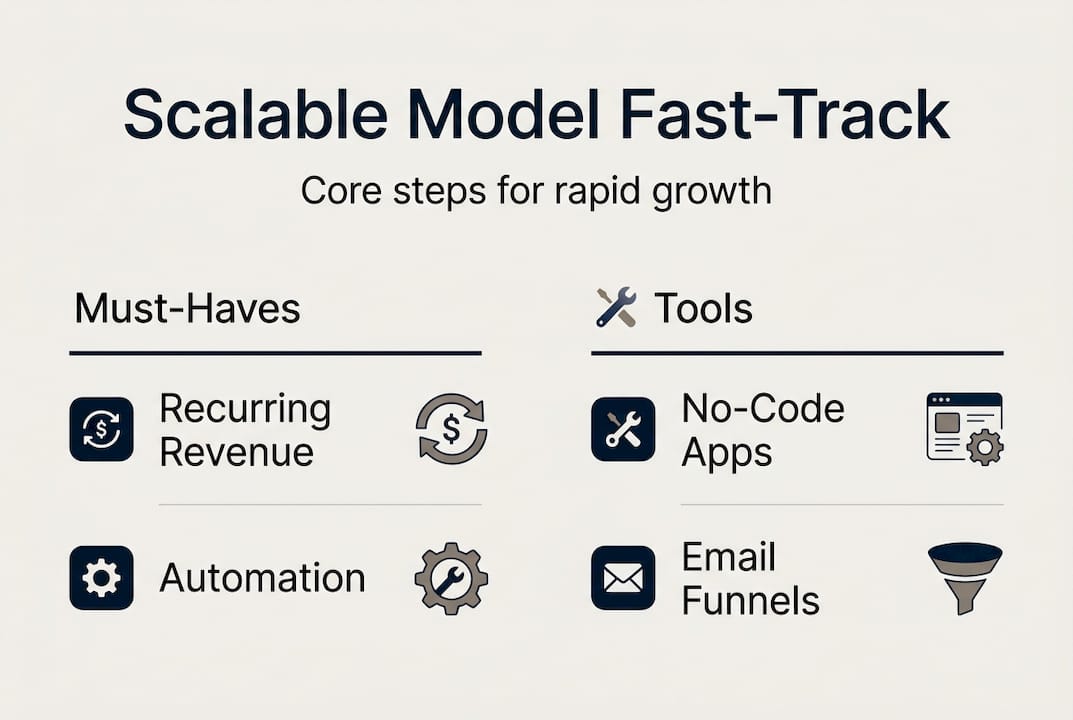
According to Capital One's business resources, key mechanics include fixed costs over variable, automation of processes, recurring revenue such as SaaS subscriptions, and leveraging platforms and no-code tools for low-skill deployment. Each of these deserves attention.
Recurring revenue is arguably the most powerful mechanic. When customers pay monthly or annually, your revenue becomes predictable and compounds over time. Subscriptions, memberships, and retainer arrangements all qualify. Fixed costs mean that as you grow, your cost per unit actually falls, which improves your margins. Automation reduces the manual work involved in delivering your product or service, meaning you can handle more volume without burning out.
Here is a quick comparison of scalable versus less scalable mechanics:
| Mechanic | Scalable | Not scalable |
|---|---|---|
| Revenue type | Recurring subscription | One-off project fees |
| Delivery method | Automated or digital | Manual, in-person |
| Cost behaviour | Fixed or declining per unit | Rising with volume |
| Customer acquisition | Paid ads, SEO, referral loops | Individual outreach only |
Steps to start automating your business today:
- Map your most repetitive tasks (invoicing, onboarding, follow-ups)
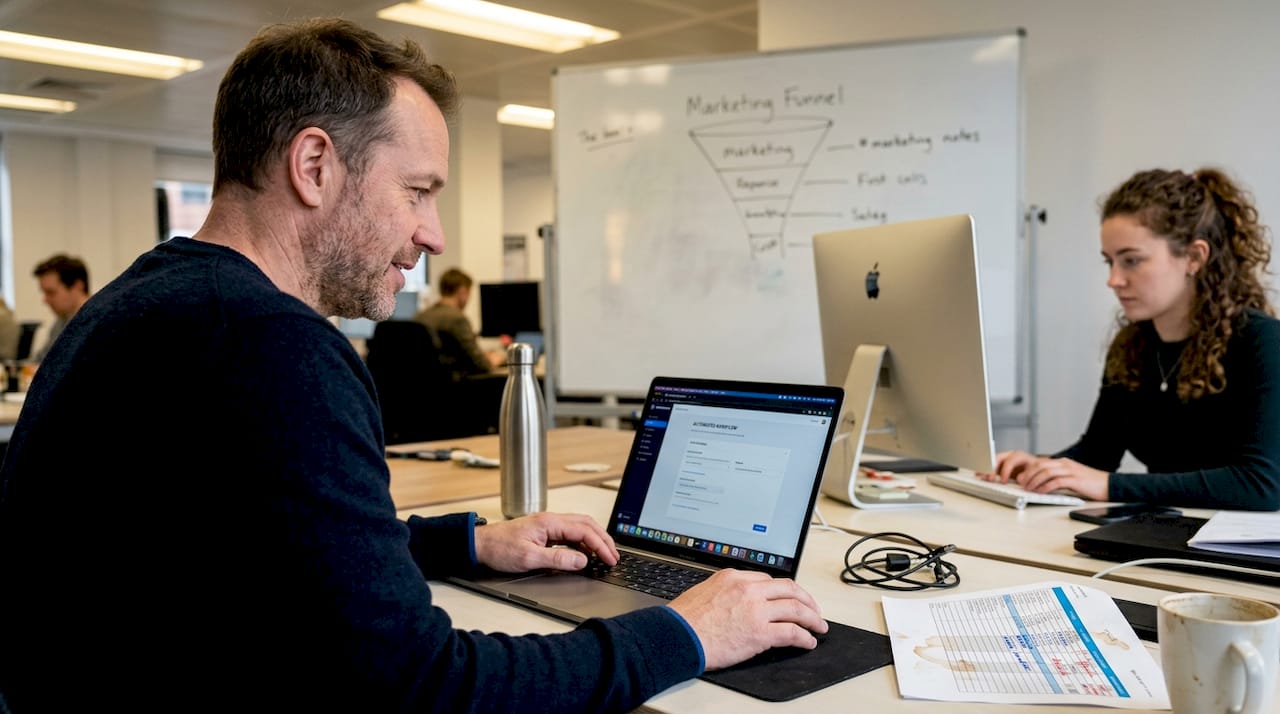
- Choose one no-code tool to automate each task (Zapier, Shopify, AI chatbots)
- Test the automated process with a small batch of real customers
- Measure time saved and error rates before expanding
- Gradually replace manual steps across your core workflow
Pro Tip: Before investing serious time or money, validate your unit economics. This means checking whether the revenue from one customer genuinely exceeds the cost of acquiring and serving them. If that number does not work at small scale, it will not magically improve at large scale.
If you want support testing your idea for scalability before committing to a full build, that early validation step can save you months of wasted effort.
Models and tools for rapid, low-tech scalability
With the mechanics in mind, you might be asking: what models are actually feasible to launch quickly? The good news is that several proven models are accessible right now, even if you have no coding background.
Common scalable models worth considering:
- SaaS (Software as a Service): Subscription-based software delivered online. High margins once built, though initial development requires investment.
- Dropshipping: Sell products online without holding stock. The supplier ships directly to your customer.
- Online courses and digital products: Create once, sell repeatedly. Platforms like Teachable or Gumroad handle delivery.
- Affiliate marketing: Earn commission by promoting other businesses' products through content or ads.
- Membership communities: Charge a recurring fee for access to content, tools, or a network.
For most aspiring entrepreneurs, the fastest path to a scalable launch involves no-code builders. Tools like Shopify for e-commerce, Webflow for websites, Zapier for automation, and AI chatbots for customer service mean you can assemble a functioning business without writing a single line of code. As Entrepreneur notes, prioritising models like dropshipping or SaaS with no-code tools allows for fast launch and early automation, which is exactly what you want when speed matters.
Validation is the step most people skip. Before building anything substantial, run the cheapest possible version of your idea past real customers. A simple landing page, a pre-sale offer, or even a manual version of the service can tell you whether demand actually exists. The scalable model options available today make this easier than ever.
Pro Tip: Start with one automated channel before adding more. A single well-functioning email sequence or checkout flow will teach you more than five half-built systems running simultaneously.
You can explore fast validation tools to test your concept before committing to a full launch.
Pitfalls, edge cases and sustainable scaling
Even the best-prepared models face real risks. Let's get honest about what can go wrong when scaling.
The most common mistakes I see:
- Premature scaling: Hiring, spending, and building before you have proven demand. This burns cash faster than revenue can replace it.
- Ignoring unit economics: Assuming that volume will fix a broken margin. It rarely does.
- Underestimating costs at scale: Costs that seem trivial at small volume can become serious liabilities as you grow.
- Over-automating too early: Automating a broken process just produces broken results faster.
- Neglecting customer feedback: Scaling a product people do not actually want is a costly lesson.
There is an important debate in entrepreneurship circles between blitzscaling and sustainable growth. Blitzscaling prioritises speed above all else, often burning through venture capital to capture market share quickly. Sustainable scaling, by contrast, focuses on profitable unit economics and self-funding growth. As Harvard Business School's research shows, diseconomies from rapid scaling, including communication breakdowns and unbounded AI inference costs, can lead to negative margins at scale. Growth at all costs fails without solid unit economics underneath.
"Speed without economics is just an expensive way to find out your model does not work."
The sustainable versus blitzscaling debate is particularly relevant today. Many founders who chased rapid growth found themselves with impressive user numbers and terrible margins. Real-world edge cases include AI-powered businesses where inference costs scaled faster than revenue, and e-commerce brands where customer acquisition costs rose sharply as they expanded into new markets.
The smarter path is to validate with real customers early, prove your unit economics at small scale, and then invest in growth. Explore AI and economic viability if your model involves AI-driven delivery, as the cost structure deserves careful scrutiny.
A smarter approach to launching a scalable business in 2026
Here is something I have come to believe strongly after working across multiple business launches: the founders who succeed at scaling are almost always the ones who started unscalably. They did things manually first. They spoke to every customer personally. They delivered the service by hand before they automated it. That is not a weakness. That is the smartest possible validation strategy.
The conventional wisdom says to automate early and scale fast. My experience says the opposite. Manual early work teaches you exactly what to automate and why. It reveals the friction points, the customer objections, and the delivery gaps that no software will fix if you skip that learning phase.
I have seen growth-hacking approaches lead to negative margins more times than I can count. Impressive traffic numbers, clever funnels, and viral campaigns built on a model that simply did not work economically. The fix is always the same: go back to basics, prove the unit economics, and build the automation around a process that already works.
Focus on process repeatability and validated revenue, not assumed scale. If you want to see what this looks like in practice, take a look at the results from our launches to understand how real scalable businesses are built from the ground up.
Ready to build your scalable business?
If this guide has helped clarify what scalability actually means and how to approach it practically, the next step is straightforward. Kalynto specialises in taking your idea and turning it into a fully operational, scalable business within 7 to 10 days. That includes the website, the brand, the backend systems, and the automation.
You do not need technical skills or months of planning to get started. You can validate your idea now to check whether your concept has the foundations for scalability before committing to a full build. Or, if you are ready to see what a complete launch looks like, explore the businesses we help scale for real examples of what is possible.
Frequently asked questions
What is a good example of a scalable business model?
A SaaS product that sells online subscriptions is a strong example, as it can add thousands of users with only a small increase in costs. Recurring revenue with minimal marginal cost is the defining characteristic.
Why do some businesses fail to scale even with automation?
If unit economics are unproven or costs rise faster than revenue, automation alone will not save the model. As Harvard Business School highlights, growth without solid unit economics consistently leads to failure.
Can a service business be scalable?
Yes, by standardising offerings, using digital delivery, and automating processes, service businesses can scale efficiently. Automation and repeatable processes are the key levers for making services scalable.
What's the best way to validate a scalable idea quickly?
Launch a simple version for real customers and check whether demand and margins hold before investing further. Early manual validation is consistently the most reliable method before committing to automation.